

The Secret Season: Why Cairns in June and July is the Best-Kept Travel Secret in Australia
- Ramada Cairns

- Jun 15
- 6 min read

There's a version of Cairns that most travellers never get to see. It's not the one slicked with summer downpours, where humidity wraps around you like a wet towel and the rivers run brown and swollen. It's not the chaotic peak of school holidays either, when every snorkelling boat is standing-room-only and hotel prices stretch toward the stratosphere.
No — the Cairns that belongs to June and July is something else entirely. It's cooler, clearer, and quietly extraordinary. If you've ever been on the fence about visiting Far North Queensland, let this be the push you needed.

The Weather: Nothing Short of Perfect
Let's get the most important detail out of the way first. June and July fall squarely in Cairns' dry season, and the difference from the wet season months is staggering. Daytime temperatures hover in the low-to-mid 20s (°C), evenings drop to a pleasant 17–18°C, and the sky is almost offensively blue, day after day.
There is no humidity to speak of. The air feels clean and light. You can walk the Esplanade at noon and not feel like you're being slow-roasted. For travellers coming from the southern states — or from Northern Europe, the US, or Northeast Asia — it feels less like a tropical escape and more like the most gorgeous spring day you've ever experienced, dialled up to eleven.
The trade-off? There's essentially none. The ocean is warm (around 23–24°C), the visibility underwater is at its annual peak, and the marine stingers (box jellyfish) that plague the beaches in summer are largely absent. You can swim freely. You can breathe freely. It is, by almost every metric, the ideal time to visit.

The Great Barrier Reef: A World Beneath the Surface
If you come to Cairns and don't make it out to the Reef, you've made a grave mistake. And in June and July, the Reef rewards you like no other time of year.
Visibility in the water during the dry season can stretch to 30 metres or more. Colours that look washed out in photos suddenly make sense when you're floating weightless above a coral garden, watching parrotfish gnaw at formations older than European settlement on the continent. Giant clams the size of bathtubs. Turtles that glide past with the unhurried grace of something that has absolutely nowhere to be.
Day trips depart from the Reef Fleet Terminal in central Cairns to iconic spots like Michaelmas Cay, Agincourt Reef (a stunning ribbon reef on the outer edge of the continental shelf), and Moore Reef. Operators like Silversea Cruises and Sunlover Reef Cruises offer everything from introductory dives for first-timers to multi-day liveaboard experiences for serious divers who want to explore deeper, more remote sections of the reef system.
If you've only ever snorkelled, consider taking the plunge — literally — and doing your first Discover Scuba dive. Most day-trip boats offer introductory dives with an instructor, no certification required. Hovering at ten metres, looking up at the surface and then back down at the coral, is the kind of moment that rewires something in your brain permanently.

The Daintree: Ancient, Alive, and Unmissable
About two hours north of Cairns lies something that might be even more extraordinary than the Reef — though you'll never get locals to agree on which is better. The Daintree Rainforest is the oldest tropical rainforest on Earth, a living relic that has been continuously growing for over 135 million years. For context: the dinosaurs were still around when this forest was already ancient.
In June and July, the roads are passable and the rivers are manageable, making this the perfect time to explore properly. Cross the Daintree River ferry — a small cable ferry that still feels delightfully low-tech — and enter a world that operates on its own logic. The Wet Tropics World Heritage Area is home to species found nowhere else on the planet: the southern cassowary, a towering, iridescent bird that looks prehistoric because it essentially is; the Boyd's forest dragon; the Ulysses butterfly, a flicker of electric blue that catches your eye and then seems to vanish like a hallucination.
Walk the Jindalba Boardwalk at dawn when the mist is still low and the birds are at full volume. Take a guided night walk and meet tree kangaroos and sugar gliders going about their lives in the dark. Stop in the small town of Mossman for a hearty breakfast and continue to the Mossman Gorge, where clear water pools among granite boulders under a canopy so dense it feels like a natural cathedral.
The Daintree in winter light — golden and soft — is something genuinely special.

Cape Tribulation: Where Two World Heritage Sites Meet
Push north past the Daintree River ferry and you'll reach a place with one of the most evocative names in Australia: Cape Tribulation, named by James Cook after his ship struck a reef here in 1770. The irony is that what Cook found catastrophic, modern travellers find breathtaking.
Here, the Daintree Rainforest meets the Coral Sea. The two World Heritage sites — the Wet Tropics Rainforest and the Great Barrier Reef Marine Park — collide at the shoreline. You can stand on a beach with jungle pressing against your back and the reef glittering offshore. It's a place that makes you feel quietly convinced the world is not beyond saving.
In June and July, the beaches here are clean and uncrowded. Swim with caution (always check local signage), explore the Kulki Boardwalk to the cape headland, and spend the night at one of the eco-lodges nestled in the forest. Waking up here, surrounded by the sounds of the jungle, is unlike waking up anywhere else.
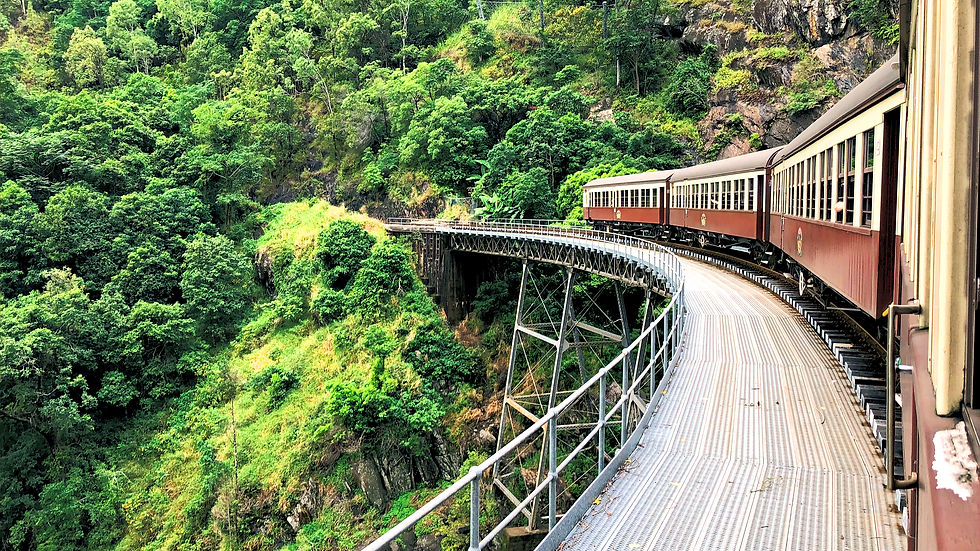
Kuranda: The Village in the Rainforest
If you want something a little more leisurely, a day trip to Kuranda is essential. And the journey is half the experience.
Take the Skyrail Rainforest Cableway — a gondola that floats over the top of the rainforest canopy and then dips down to mid-stations where you can walk among the trees — and return on the Kuranda Scenic Railway, one of the most beautiful train rides in Australia. The railway winds through the Barron Gorge, crossing 15 tunnels and 37 bridges, with views that occasionally make passengers go very quiet.
Kuranda itself is a small, eccentric village full of markets, wildlife sanctuaries, and art galleries. Visit the Rainforestation Nature Park to hold a koala, meet Aboriginal cultural performers, and take an Army Duck tour through the rainforest. In the dry season, the famous Barron Falls — which thunder impressively during the wet — are more subdued, but the gorge they've carved is still spectacular.

Cairns Itself: More Than Just a Gateway
It would be easy to treat Cairns purely as a launching pad for day trips, but the city has more to offer than its reputation suggests.
The Cairns Esplanade is one of the best waterfront promenades in Queensland — a long, palm-lined walkway that curves alongside a tidal mudflat (the actual ocean is too shallow for swimming here) and leads to the famous Esplanade Lagoon, a free public swimming lagoon that fills with locals and travellers every afternoon. On a warm July evening, with families and backpackers and retirees all sharing the same patch of cool water as the sun goes down, it captures something genuinely lovely about Far North Queensland's social character.
The Cairns Night Markets on Abbott Street are busiest in the dry season — browse crafts, taste local produce, and grab dinner from the diverse food stalls. The central dining precinct around Shields Street and Grafton Street has expanded significantly in recent years, with quality restaurants serving fresh seafood, modern Australian cuisine, and excellent Southeast Asian food reflecting the region's cultural diversity.
For the culturally curious, the Cairns Museum and the Tanks Arts Centre (a converted World War II fuel storage facility — yes, really, and it's extraordinary inside) are both worth an afternoon.
Practical Notes for the June–July Traveller
Getting there: Cairns Airport is well-connected to Sydney, Melbourne, Brisbane, and several international destinations. The city centre is just 10 minutes from the terminal.
Getting around: Many tours include hotel pickup, but having a hire car opens up the Daintree, Cape Tribulation, and the Atherton Tablelands properly. Roads in the dry season are in excellent condition.
Where to stay: Options range from backpacker hostels on the Esplanade to luxury eco-lodges deep in the Daintree. The Pullman Cairns International and Riley, a Crystalbrook Collection Resort are the top-end picks in the city. For the full immersion experience, consider a night or two at Silky Oaks Lodge near Mossman — it sits over the Mossman River and is exactly as magical as it sounds.
Book reef trips early: Even in the shoulder season, popular reef operators fill up. Book your preferred day trip before you arrive.
The Final Word
There's a particular quality to travelling somewhere at exactly the right time — when the conditions, the crowds, and the season all align to show a place at its very best. In Cairns, that moment is June and July.
The reef is clear. The forest is accessible. The weather is extraordinary. And the city itself, unhurried by the frenzy of peak school holidays, feels like a place that's glad you came.
Go to Cairns in winter. You'll wonder why anyone goes in summer.
Far North Queensland awaits. The only question is which wonder to visit first.


Comments